



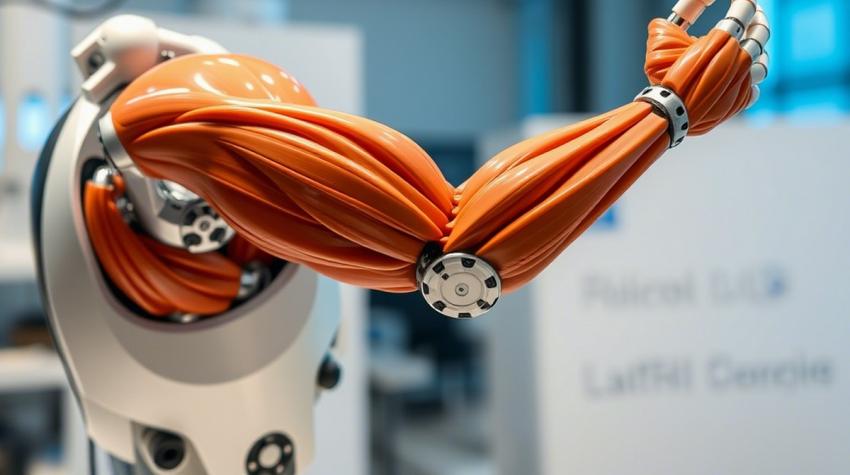
Scientists at the University of Bristol have developed a mechanical system that mirrors the way human muscles respond to increasing strain — a breakthrough that could transform the future of soft robotics and bio-inspired machines. Using small electric motors, 3D-printed parts and laser-cut acrylic, the research team built a simplified physical model that reproduces the collective behavior of actomyosin, the molecular machinery that drives muscle contraction in living tissue.
Although the device contains no biological material and relies on basic mechanical interactions rather than complex chemistry, it successfully demonstrates a hallmark feature of real muscle: the ability to recruit additional “motors” as load increases. In the human body, muscle contraction depends on the coordinated action of actomyosin proteins, which generate force through intricate biochemical processes. Instead of attempting to recreate those chemical reactions, the Bristol researchers focused on the system’s physical architecture.
They designed a network in which individual motors interact only through brief mechanical contact within a carefully arranged structure. As each motor pushes against a shared backbone, it changes the forces experienced by neighboring motors. Over time, this interaction leads to synchronised, wave-like motion across the network.
Remarkably, the tabletop device spontaneously self-organised into coordinated traveling waves and automatically adjusted its output when additional mechanical load was applied — closely resembling how muscles increase force when needed. The findings suggest that muscle-like coordination may emerge not only from biochemical signaling but also from structural design and mechanical connectivity.
The research offers new insight into how complex biological behaviors can arise from relatively simple physical rules. For engineers, it opens the possibility of building adaptive artificial muscles that respond dynamically to changing conditions without requiring sophisticated programming or centralised control.
“On the engineering side, we’re interested in whether these ideas could help design artificial muscles or soft robotic systems that adapt automatically,” said Bloomfield-Gadêlha, senior lecturer in Applied Mathematics and Data Modelling at the University of Bristol, in a statement.
Such technology could lead to softer, more flexible robots capable of moving more naturally and efficiently. By relying on structural design rather than heavy computational control, future systems may become more resilient and energy-efficient. Beyond robotics, the study raises important biological questions.
If coordinated muscle behavior can arise from mechanical structure alone, scientists may need to rethink how much of muscle performance depends on chemical signaling versus physical organisation. Understanding this balance could improve knowledge of muscle aging and disease, including conditions such as Muscular Dystrophy.
In the long term, the findings may help inform new approaches to studying muscle failure and developing therapeutic strategies. By demonstrating that complex, life-like behavior can emerge from simple mechanical interactions, the Bristol team has taken a step toward bridging biology and engineering — and toward a future where machines move with muscle-like intelligence.