

• About
  • Advertise
  • Privacy & Policy
  • Contact
Research Television
Advertisement
  • Home
  • Research News
    • World
    • Africa
    • Europe
    • Asia
    • Pacific
    • Oceanic
    • Politics
  • Research Business
    • Agriculture
    • Energy
    • Manufacturing
    • Services
    • Tech
  • Research Style
    • Community
    • Culture
  • Research Entertainment
    • Movies
    • Music
  • Research Technology
    • Innovation
    • Science
  • Research Education
  • Research Environment
  • Research Health
  • Research Security
  • Research Sports
    • Football
    • Basketball
    • Golf
    • Tennis
  • Research Religion
  • LIVE
No Result
View All Result
  • Home
  • Research News
    • World
    • Africa
    • Europe
    • Asia
    • Pacific
    • Oceanic
    • Politics
  • Research Business
    • Agriculture
    • Energy
    • Manufacturing
    • Services
    • Tech
  • Research Style
    • Community
    • Culture
  • Research Entertainment
    • Movies
    • Music
  • Research Technology
    • Innovation
    • Science
  • Research Education
  • Research Environment
  • Research Health
  • Research Security
  • Research Sports
    • Football
    • Basketball
    • Golf
    • Tennis
  • Research Religion
  • LIVE
No Result
View All Result
Research Television
No Result
View All Result
Home Research Technology Innovation

US team makes history with World’s First Teleoperated Humanoid Robots Surgery

ResTV by ResTV
July 14, 2026
in Innovation
0
US team makes history with World’s First Teleoperated Humanoid Robots Surgery
0
SHARES
0
VIEWS
Share on FacebookShare on Twitter

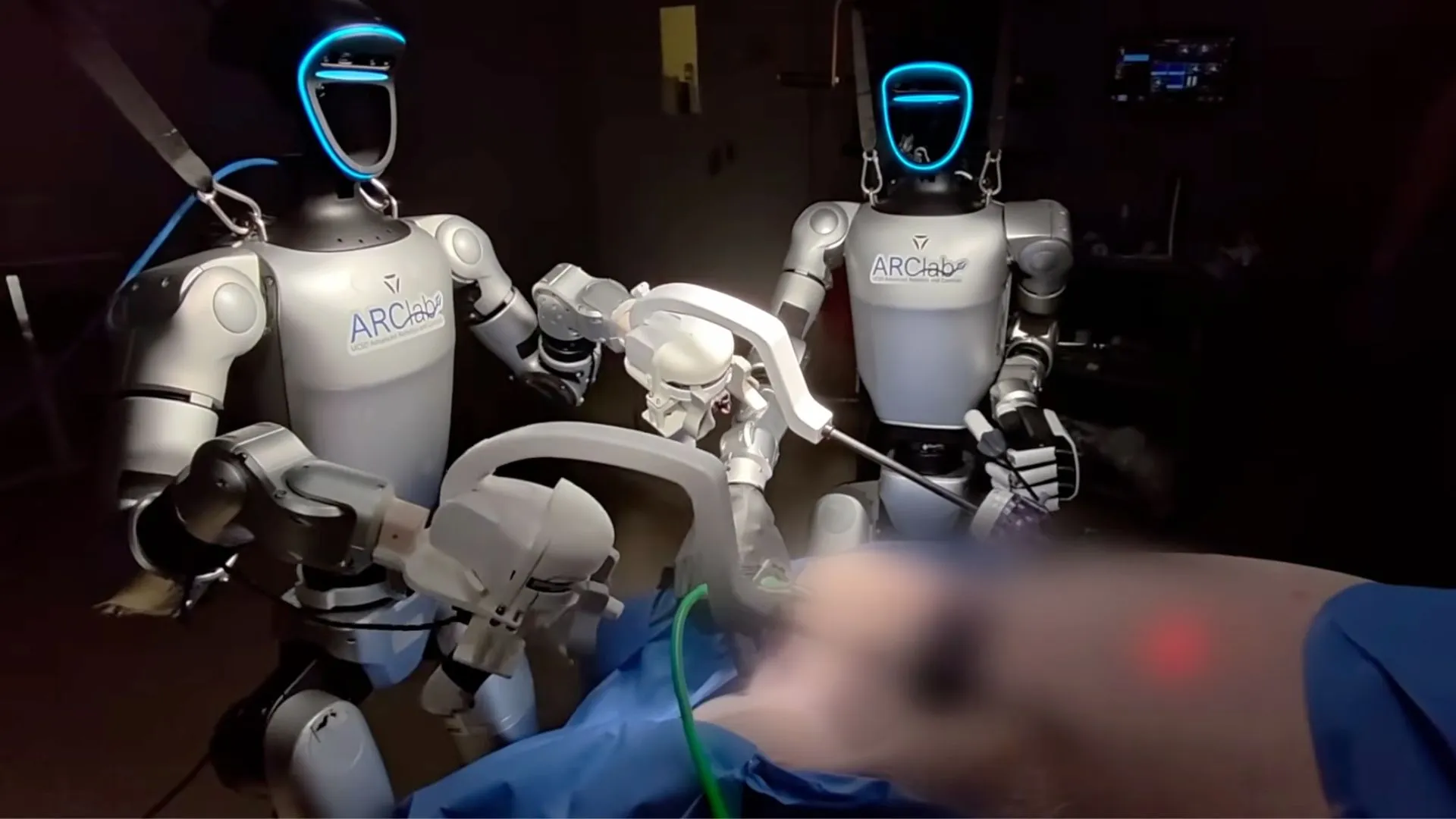
According to researchers, the milestone demonstrates the potential for teleoperated humanoid robots to support surgeons in operating rooms, with future applications ranging from surgical assistance to remotely performed procedures. 

Teleoperated and autonomous humanoid robots could help address the global shortage of surgeons by expanding access to advanced surgical care, particularly in underserved regions where specialist medical services are limited. 

Their human-like form and versatility allow them to perform a broader range of clinical and support tasks than conventional robotic surgery platforms, making them suitable for hospitals, remote communities, disaster zones, and search-and-rescue operations. 

According to the team, current robotic surgery systems are highly specialized, typically featuring three or four robotic arms, proprietary software, and dedicated surgical instruments. 

Weighing around 1,800 pounds (816 kg), these systems require purpose-built operating rooms, extensive setup, and trained support staff, making them costly and difficult to deploy outside major medical centres. 

By contrast, the humanoid robots used in the study, called Surgie, stand about 5 feet (1.5 meters) tall and weigh only 60 pounds (27 kg). 

Their compact, mobile design allows them to operate within existing operating rooms without major infrastructure changes, making them more practical for resource-limited healthcare facilities. 

To enable surgical procedures, researchers equipped the robots with adapters that allowed them to use standard surgical instruments. The robots integrated smoothly into existing clinical workflows, and operators reported that their human-like controls felt more intuitive than those of traditional robotic surgery systems. 

UCSD team claims that in the preclinical trials, the teleoperated humanoid robots achieved surgical precision comparable to established robotic platforms, demonstrating that compact humanoid systems could deliver high-quality surgical performance while making advanced care more accessible in challenging environments. 

While the study demonstrated the feasibility of teleoperated humanoid surgery, several technical challenges remain before the technology can be widely adopted. 

During the procedures, the robots required multiple recalibrations, increasing the overall operating time compared with conventional robotic surgical systems. 

Researchers noted that such limitations are common in the early stages of new surgical technologies, pointing out that the first robotic laparoscopic procedures once took several hours but have since been reduced to around 30 minutes through continued refinement. 

Another challenge is communication latency— the delay between a surgeon’s control inputs and the robot’s movements. Reducing this delay will be critical as researchers work toward enabling long-distance teleoperated surgeries in remote and underserved communities. Beyond performing surgical procedures, the team envisions humanoid robots taking on a broader role in operating rooms. 

ResTV

ResTV

Stay Connected test

  • 23.9k Followers
  • 99 Subscribers
  • Trending
  • Comments
  • Latest
7 Key Things to Know About the Nile University EMBA Program

7 Key Things to Know About the Nile University EMBA Program

May 30, 2025
yamal

Yamal Shines as Barcelona Clinch La Liga Title and Complete Domestic Treble

May 30, 2025
trump in doha

Trump Lifts Sanctions on Syria Following Historic Meeting with President al-Sharaa

May 30, 2025
President Tinubu to Attend Pope Leo XIV’s Inauguration in Rome

President Tinubu to Attend Pope Leo XIV’s Inauguration in Rome

May 30, 2025
Dangote, Trump Exchange Pleasantries During High-Profile Visit To Qatar

Dangote, Trump Exchange Pleasantries During High-Profile Visit To Qatar

1
wimmer mike

Teenage Prodigy Mike Wimmer Unveils his Invention at Graduation

0
solar probe

Parker Solar Probe Brings Humanity Closer Than Ever to the Sun

0
JD Vance

VP Vance: Ukraine War Far From Over, US Role Now About ‘Finding Middle Ground’

0
US team makes history with World’s First Teleoperated Humanoid Robots Surgery

US team makes history with World’s First Teleoperated Humanoid Robots Surgery

July 14, 2026
Chinese firm builds world’s largest hybrid solar plant to supply power at night

Chinese firm builds world’s largest hybrid solar plant to supply power at night

July 14, 2026
Session Telecoms to challenge ICASA R6m fine, calls for industry-wide fraud inquiry

Session Telecoms to challenge ICASA R6m fine, calls for industry-wide fraud inquiry

July 14, 2026
US Army awards another $84m contract for its hack-proof Falcon radios

US Army awards another $84m contract for its hack-proof Falcon radios

July 14, 2026

Recent News

US team makes history with World’s First Teleoperated Humanoid Robots Surgery

US team makes history with World’s First Teleoperated Humanoid Robots Surgery

July 14, 2026
Chinese firm builds world’s largest hybrid solar plant to supply power at night

Chinese firm builds world’s largest hybrid solar plant to supply power at night

July 14, 2026
Session Telecoms to challenge ICASA R6m fine, calls for industry-wide fraud inquiry

Session Telecoms to challenge ICASA R6m fine, calls for industry-wide fraud inquiry

July 14, 2026
US Army awards another $84m contract for its hack-proof Falcon radios

US Army awards another $84m contract for its hack-proof Falcon radios

July 14, 2026
Research Television

Research is in everything and everything is in research

Follow Us

Centre for Petroleum, Pollution and Corrosion Control

African Journal of Engineering and Environmental Research

Research Newspaper

Browse by Category

  • Africa
  • Agriculture
  • Asia
  • Basketball
  • Community
  • Culture
  • Energy
  • Europe
  • Football
  • Golf
  • Innovation
  • Manufacturing
  • Movies
  • Pacific
  • Politics
  • Research Automobile
  • Research Business
  • Research Education
  • Research Entertainment
  • Research Environment
  • Research Health
  • Research News
  • Research Religion
  • Research Security
  • Research Sports
  • Research Style
  • Research Technology
  • Science
  • Services
  • Tech
  • Uncategorized
  • World

Recent News

US team makes history with World’s First Teleoperated Humanoid Robots Surgery

US team makes history with World’s First Teleoperated Humanoid Robots Surgery

July 14, 2026
Chinese firm builds world’s largest hybrid solar plant to supply power at night

Chinese firm builds world’s largest hybrid solar plant to supply power at night

July 14, 2026
  • About
  • Advertise
  • Privacy & Policy
  • Contact

© 2026 Research Television.

No Result
View All Result

© 2026 Research Television.