



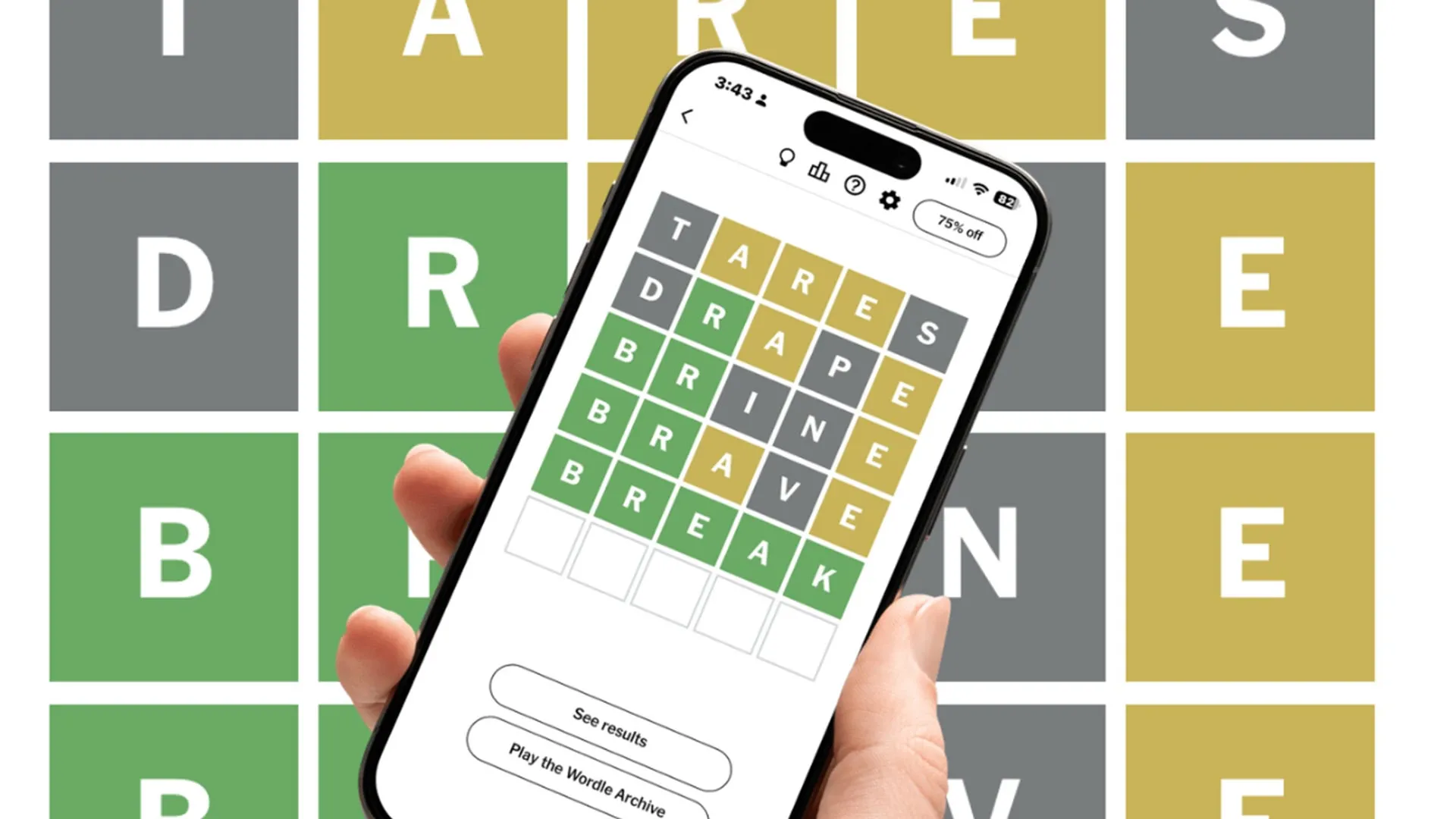
Researchers used information theory to crack Wordle, a popular, free online word-guessing game where one has six attempts to guess a hidden five-letter word. With information theory, the researchers created a strategy that solves the game, recording a tangible success at 99 percent of the time.
The Wordle-solving strategy succeeds 99 percent of the time by focusing on information gain rather than likely answers. The method uses Shannon entropy to identify guesses that reveal the most about the hidden word. Each guess is designed to slash uncertainty and narrow the possibilities faster.
This result significantly outperformed more traditional Wordle tactics. The Wordle-solving developed the research team at Binghamton University, State University of New York, is currently celebrating its fifth anniversary.
Millions of people now tackle Wordle every day, trying to uncover a hidden five-letter word in the New York Times’ wildly popular puzzle game. In the Wordle game, players have six chances to identify a secret five-letter word with each beginning with five empty squares and no clues.
When a player enters a guess, such as ‘BRAVE,’ the game responds with coloured squares that provide hints about the hidden word. Grey means the letter does not appear in the secret word. Yellow means the letter is in the word but is in the wrong position.
Green means the letter is both correct and in the correct position. Using these clues, players continue making guesses until they either find the answer and turn all five squares green or run out of attempts.
To simplify the game, the research team, led by Assistant Professor Congyu ‘Peter’ Wu, turned to Shannon entropy, a mathematical concept used to measure uncertainty. Instead of focusing on words that seem most likely to be the answer, the method identifies guesses that reveal the greatest amount of information and eliminate the largest number of possibilities.
“Let’s say you’re at a certain guess. The previous guesses will eliminate a whole bunch of options, and based on the remaining options, guessing some words will send you into a trajectory where information gain is speedier,” said Wu, a faculty member at the Thomas J. Watson College of Engineering and Applied Science’s School of Systems Science and Industrial Engineering.
According to the researchers, the key insight is that the best guess is not always the one most likely to be correct. Sometimes a more informative guess can dramatically narrow the field of possible answers.
“A subtle but important insight from the paper is that a guess doesn’t have to be the most likely answer; it simply has to be informative. “By applying Shannon entropy, the objective shifts to maximising the expected reduction in uncertainty rather than the probability of being right.
In practice, this approach can lead to solving the puzzle in fewer guesses,” said Donald Stephens, a doctoral student at Binghamton University. The strategy can appear somewhat random because it prioritises gathering information over directly pursuing the answer.
To use it while playing Wordle, a player would run a separate script/ program and enter the color-coded feedback after each guess. The programme would then recommend the next word that is expected to provide the most useful information.
To evaluate the approach, the researchers compared it with a more traditional Wordle strategy that emphasises frequently used letters (e.g., ‘A,’ ‘E,’ ‘R’). In computer simulations, the information theory-based method successfully solved 99 percent of Wordle puzzles while the conventional approach solved about 90 percent.
The project began not as a formal research initiative, but as a class assignment. Wu challenged students to demonstrate how information theory could be applied to a real-world problem.
That classroom exercise eventually evolved into a published scientific paper. Co-author, Talal Aladaileh said the journey from coursework to publication reflects the strength of Binghamton’s School of Systems Science and Industrial Engineering.
“The courses here don’t just teach concepts; they push you to apply them in ways that have real, lasting impact,” Aladaileh said.