


China’s first tension-leg platform (TLP) floating wind farm has commenced operation, marking a major step in deep-water renewable energy.
According to a statement from China National Offshore Oil Corp (CNOOC), the 16-megawatt Haiyou Anlan platform has been connected to the Lufeng oilfield power grid and is supplying renewable electricity directly to offshore oil production.
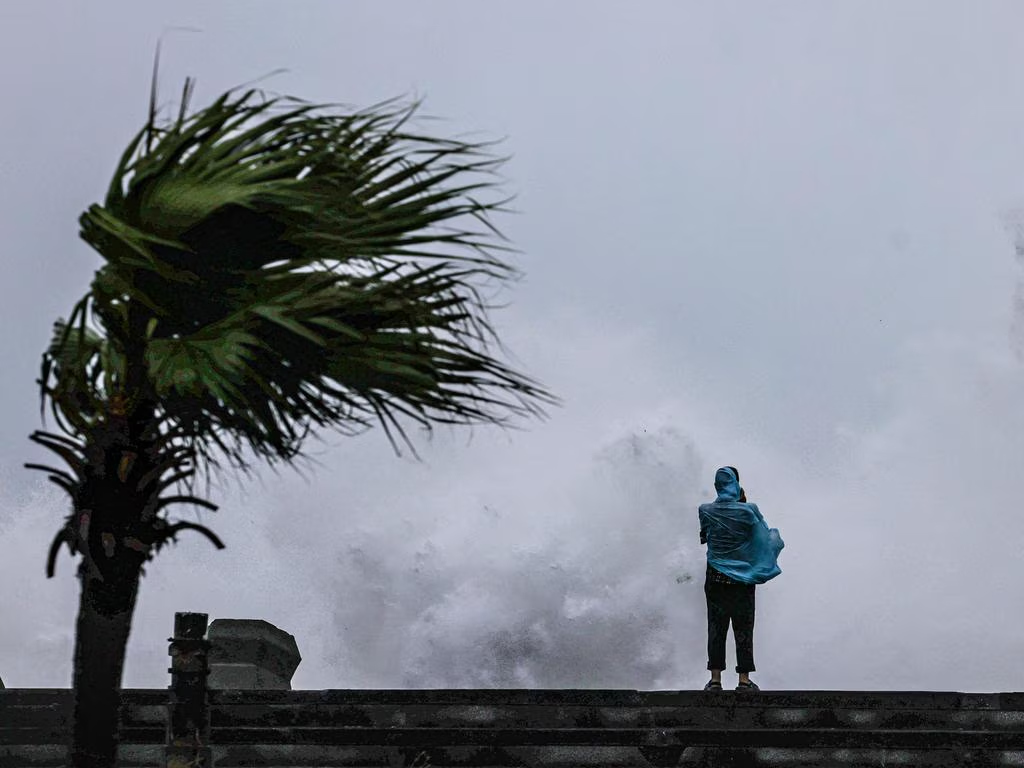
The project, which is China’s first TLP floating wind platform and the largest in the world by installed turbine capacity, is located farther offshore and in deeper waters than any similar TLP wind facility. Built to handle Level 17 typhoons, the platform shows China’s progress in floating offshore wind technology and may help future deep-sea wind projects.
Built for deep waters and extreme weather
Haiyou Anlan sits in the Pearl River Mouth Basin, about 124 miles (200 kilometers) southeast of Shenzhen in Guangdong Province. The platform is in waters around 446 feet (136 meters) deep and about 85 miles (136 kilometers) from the coast.
The structure is almost as tall as a 110-story building and holds a 16 MW typhoon-resistant wind turbine.
According to CNOOC, the facility has been designed for a service life of 25 years while withstanding powerful Level 17 typhoons.
When fully running, the corporation said, the platform should generate about 54 million kilowatt-hours of electricity each year for the Lufeng oilfield. This is expected to save around 15,000 cubic meters of fuel oil annually and reduce carbon dioxide emissions by about 35,000 metric tons.
Unlike traditional offshore wind foundations that are fixed to the seabed, tension-leg platforms float on buoyant hulls held in place by vertical tendons anchored to the ocean floor. This design keeps the platform stable and limits movement from waves and currents.
Compared to semi-submersible floating platforms, TLP systems use less steel for each megawatt of capacity, take up less sea space, and are more stable. Even with these benefits, the technology is still one of the hardest types of floating offshore wind to build because it needs very precise engineering and installation.
Haiyou Anlan weighs about 7,800 tons and sweeps an area equal to roughly 7.5 standard soccer fields. CNOOC said it developed high-strength mooring systems, high-precision anchoring technology, and a multi-equipment construction system for the project. Engineers also used a three-dimensional sea condition simulation system to achieve millimeter-level underwater connections during installation.
Director of the China Centre for Energy Economics Research at Xiamen University, Lin Boqiang, said the project represented an important technological breakthrough and points to the future of offshore wind development.
Floating wind systems can move beyond the limits of nearshore development and access stronger wind resources in deeper and more distant waters. While the core technologies for large turbines and floating platforms are already mature in China, costs remain a main challenge.
Lin said the broader significance lies in expanding the supply of green electricity in eastern China, as reported by Global Times.
More than 80 percent of the country’s wind and solar resources are concentrated in western regions, while the main centers of electricity consumption are in the east. Developing offshore wind farther from the coast could therefore bring clean power closer to major demand centers and reduce reliance on long-distance transmission from western China.
China is also expanding its wider green fuel industry. According to a report released last Wednesday by the National Energy Administration, the country has about eight million tons of oil equivalent in annual green fuel production capacity by the end of 2025, including green methanol, green ammonia, and sustainable aviation fuel.