



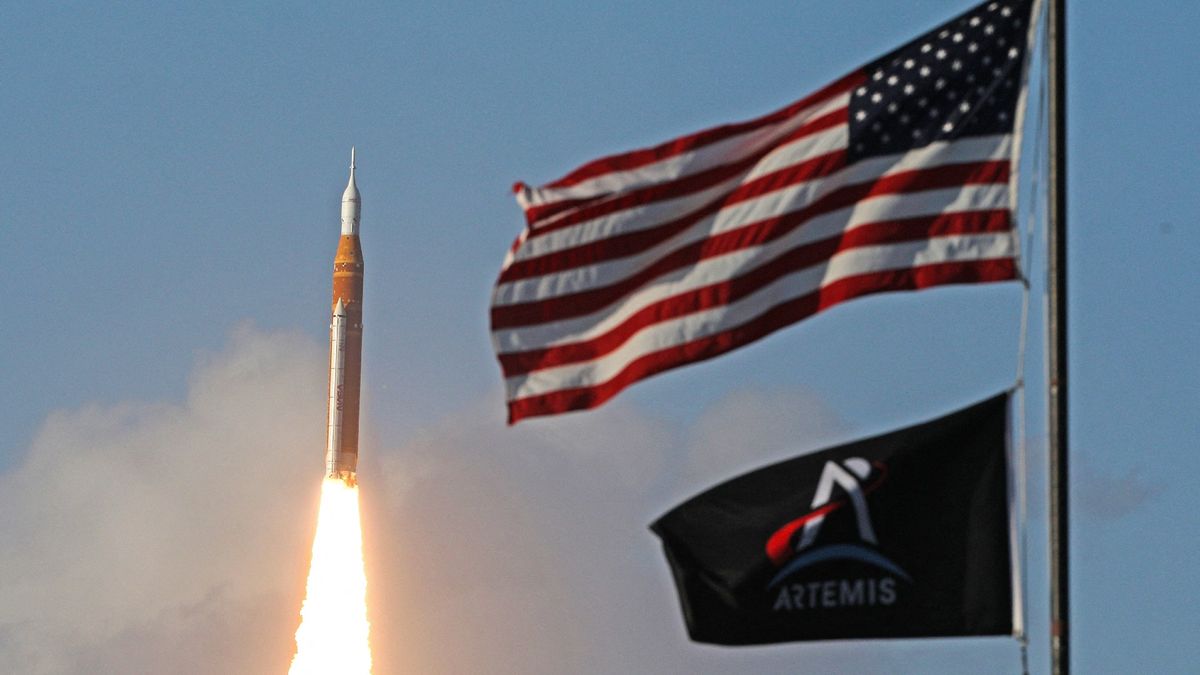
United States Aeronautic Space Administration (NASA) on April 1, 2026, launched its most powerful rocket, the Space Launch System, to light up the evening sky over Florida’s Space Coast. The stunning liftoff sent four astronauts on a 10-day voyage around the moon. The historic Artemis 2 mission was launched at 6:35pm EDT (2235 GMT) from NASA’s Kennedy Space Centre, beginning the first astronaut voyage to the moon since Apollo 17 in 1972.
Aboard their Orion spacecraft, the four Artemis 2 astronauts will perform a lunar flyby. While the astronauts won’t be orbiting or landing on the moon, the mission marks a watershed moment for NASA’s renewed effort to extend humanity’s reach beyond low Earth orbit. Speaking during the agency’s launch webcast, NASA spokesperson, Derrol Nail said “the crew of Artemis 2 now bound for the moon,” Humanity’s next great voyage begins.” Orion’s crew includes NASA astronauts, Reid Wiseman; the commander, Victor Glover; pilot, Christina Koch, and mission specialist and Canadian astronaut, Jeremy Hansen.
All three NASA astronauts are veteran spaceflyers, with long-term stints aboard the International Space Station under their belts while Hansen is a rookie on his first mission and will become the first Canadian to fly into deep space. “We have the best crew that you can put together from NASA and the Canadian Space Agency here.
We’re going to go slow and we have the ultimate trust in each other, and that’s how we will get through this,” Wiseman told reporters days before launch. This mission, full of firsts, is the first time a Space Launch System (SLS) rocket and Orion spacecraft have carried astronauts who flew an uncrewed test mission to lunar orbit on Artemis 1 in 2022).
It’s the first astronaut launch to the moon of the 21st century. Artemis 2 is also carrying the first woman, the first Black astronaut and first non-American to the moon. Orion also carries the first toilet around the moon. “Although it is something to celebrate a bunch of firsts, that’s definitely not necessarily telling the whole story, and it’s also not about celebrating any one individual.
“If there is something to celebrate, it’s that we are at a time when everyone who has a dream gets to work equally hard to achieve that,” Koch told reporters on March 29. The distance Artemis 2 will fly from Earth is also a spaceflight first. When they loop around to the far side of the moon, the astronauts will get farther from Earth than any humans in history.
They’ll be 252,799 statute miles (406,841 kilometers) from Earth at the time, about 4,000 miles (6,400 kilometers) farther than the previous record set by NASA’s Apollo 13 astronauts in 1970. And while that record is remarkable, NASA is more focused on how the crew will spend their time during their journey around the moon. “You want every mission to keep exploring and keep learning new things,” Artemis 2 flight director Emily Nelson told reporters before launch.
“Getting farther from Earth than we’ve ever been before is a fun statistic, but there are a lot of other things we’re going to learn on this mission that are going to be a lot more exciting for me.” The Artemis 2 SLS lifted off from Launch Complex 39B here at NASA’s Kennedy Space Center, ascending into the sky as the setting sun shone a golden light onto the booster’s exhaust trail. A huge crowd watched this happen: More than 400,000 people likely descended on Florida’s Space Coast to view the moonshot, experts have estimated.