


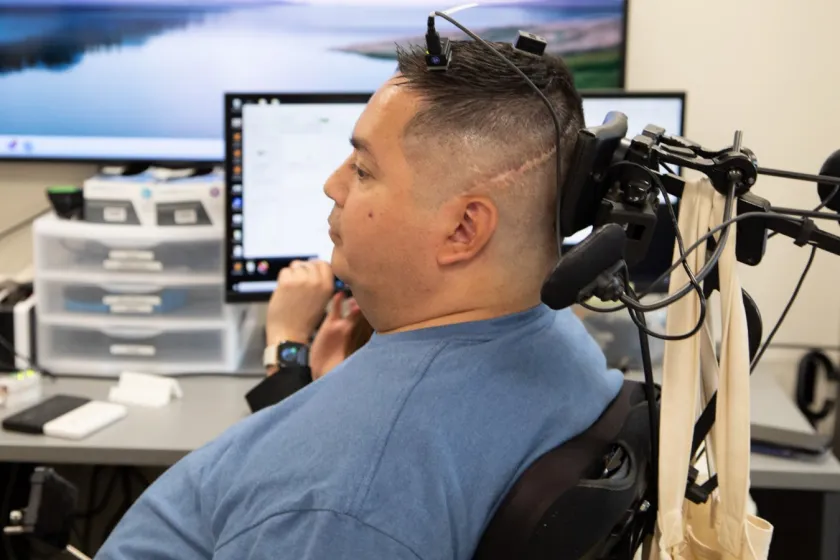
Scientists have found that precisely targeted electrical stimulation of the brain can recreate a sense of touch in people with spinal cord injuries.
Researchers at the University of Pittsburgh and the University of Chicago followed five people with spinal cord injuries who received implanted braincomputer interface devices. Over a combined 27 years of implant use, the systems delivered about 168 million electrical pulses to the brain without causing any serious adverse events.
Published in Science Translational Medicine, the study is the longest investigation so far of intracortical microstimulation in humans. It provides rare evidence that artificial touch signals can remain safe and relatively stable not just for months, but for years.
“This research plants a flag in the ground for the safety and utility of using brain-computer interfaces to deliver sensory stimulation in clinical settings and, eventually, in people’s homes.
“For brain-computer interfaces to have real impact on people’s lives, they need to keep working safely and reliably for years. This study shows that microstimulation in the brain can do exactly that,” said senior author Robert Gaunt, associate professor of physical medicine and rehabilitation and a member of Pitt’s Rehab Neural Engineering Labs, School of Medicine.
Brain-computer interfaces, or BCIs, translate neural activity into commands that can operate computers, robotic limbs, and other devices.
Some systems also work in reverse by sending information into the brain. In this case, tiny electrical pulses were delivered to the somatosensory cortex, the region that processes touch from the body.
That feedback could be crucial for making neuroprosthetic devices more useful. People normally rely on touch to judge pressure, grip strength, texture, and contact. Without it, controlling a robotic hand depends heavily on vision and can require far more concentration.
Pitt’s Rehab Neural Engineering Labs and researchers at the University of Chicago have helped push the field forward for more than a decade.
In 2012, a Pitt investigatorled team was among the first to implant electrodes in the motor cortex so a paralyzed person could control a robotic arm. By 2015, the researchers were stimulating the sensory cortex to add a sense of touch.
The University of Chicago implanted its first participant with electrodes in both the motor and sensory cortex in The five volunteers in the new study allowed researchers to address questions that short experiments cannot answer.
They examined whether repeated stimulation caused harmful effects, whether artificial sensations spread to unintended parts of the body, and whether those sensations weakened or changed with time.
The results were encouraging, as electrical pulses aimed at the hand area of the somatosensory cortex continued to produce sensations associated with the hand. Even after years of stimulation, those sensations did not drift to unrelated regions of the body.
Lingering effects were also uncommon. A “persistent sensation” occurred only about once every 23,000 stimulation trials, on average. Most disappeared within 10 seconds after stimulation stopped.
None caused pain, and none required medical treatment.
The main limitation was declining electrode performance.
Across participants, an average of 64 percent of the electrodes remained functional.
In one person, 60 percent were still working after 10 years in the brain, although the rate of decline increased later in the study.
“This shows that this technology doesn’t just have to be a short-term solution we test in the lab; industry can start developing longterm take-home solutions for patients,” said lead author Charles Greenspon, an assistant professor in the Department of Neurological Surgery at the University of Chicago.