


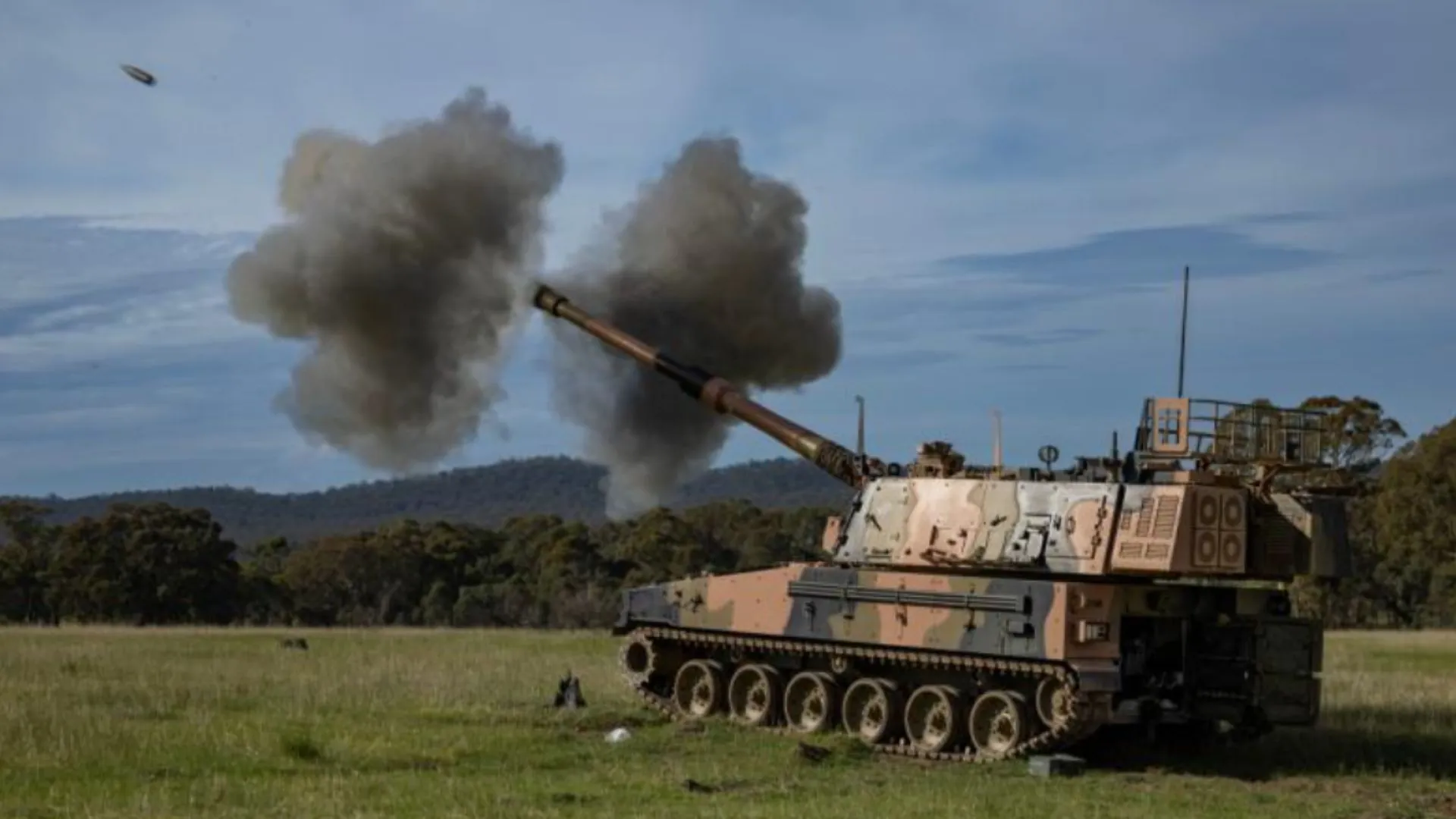
Australia’s has completed f irst live-firing training for its locally-manufactured armoured artillery force in Victoria. T his is a major step towards building the country’s own armored artillery force, the AS9 Huntsman howitzers.
The milestone highlights how quickly Canberra is moving to field modern battlefield systems while expanding domestic defense production capacity. T he vehicles rolled off Hanwha Defence Australia’s production line in Geelong only months before the exercise.
That turnaround reflects a faster acquisition cycle than many Western armies achieved with previous artillery programmes. T hirty soldiers from the 4th Regiment, Royal Australian Artillery, fired the tracked 155 mm systems after completing a six-week operator course at the School of Artillery in Puckapunyal.
The Australian Defence Department confirmed the exercise marked the first training deployment of Australian-built AS9 crews. T he AS9 Huntsman is Australia’s version of South Korea’s K9 Thunder selfpropelled howitzer. The K9 family already serves with several NATOaligned militaries, including Poland, Norway, Finland, Estonia, and India.
Australia selected the platform to replace older towed artillery systems and improve survivability on modern battlefields. Unlike traditional guns require manual positioning procedures. that require lengthy setup procedures, the AS9 can halt, calculate firing data, launch rounds, and relocate rapidly.
The system uses an automated gun-laying process. Crews enter firing information digitally, and the howitzer positions the cannon automatically. Soldiers then load and fire the weapon. That process sharply reduces setup time compared with towed systems like the M777, which still Commanding officer of the School of Artillery, Lieutenant Colonel Chris D’Aquino said the new platform changes how Australian troops deliver f ire support.
“This capability enhances how we deliver firepower. It’s protected, mobile and far more responsive than what it replaces,” he said. Modern artillery crews face growing threats from drones, counterbattery radar, and precision-guided weapons. Military planners increasingly value systems that can fire and relocate before enemy forces pinpoint their location.
The AS9 addresses that challenge with so-called “shoot-and-scoot” tactics. The tracked vehicle can rapidly leave a firing position seconds after launching rounds. Australian officials say the Huntsman gives crews better protection while maintaining long-range fire support.
The system fires NATO-standard 155 mm ammunition and can strike targets roughly 25 miles away using extended-range rounds. T he live-fire exercise also underscored Australia’s effort to strengthen domestic weapons manufacturing. Hanwha Defense Australia builds the AS9 in Geelong under a sovereign industrial capability agreement with Canberra.