


India is set to record a major milestone in its space ambition, as one of it startups, Skyroot Aerospace, has announced that it would launch its Vikram-I rocket in August, marking the country’s first attempt to send a privately developed orbital launch vehicle into space.
Scheduled to lift off between July 12 and August 4 from ISRO’s Satish Dhawan Space Centre in Sriharikota, the mission has been named Mission Aagaman, symbolising the arrival of a new era for India’s growing private space sector. If successful, Vikram-I will place Skyroot among a small group of private companies worldwide that have independently developed and launched orbital rockets, a list that includes industry leaders such as SpaceX and Rocket Lab.
The significance of Mission Aagaman extends far beyond a single launch. India opened its space sector to private participation only in 2020. Since then, several startups have built satellite technologies, propulsion systems, and rocket engines. However, independently reaching orbit has remained the biggest challenge. The significance of Mission Aagaman extends far beyond a single launch.
India opened its space sector to private participation only in 2020. Since then, several startups have built satellite technologies, propulsion systems, and rocket engines. However, independently reaching orbit has remained the biggest challenge.
A successful Vikram-I mission would demonstrate that Indian private companies are now capable of building and launching complete orbitalclass rockets, creating new opportunities for commercial satellite launches and strengthening India’s position in the global space economy.
It would also reduce pressure on ISRO by allowing private firms to handle commercial launch requirements while the national space agency focuses on ambitious missions such as Gaganyaan, the Bharatiya Antariksh Station, planetary exploration, and advanced launch systems.
Unlike a routine commercial launch, Mission Aagaman is primarily an engineering demonstration. Although Vikram-I will carry several domestic and international payloads, the mission’s biggest objective is to gather real flight data. Skyroot Aerospace cofounder and chief executive, Pawan Chandana said the rocket’s actual value lies in understanding how its propulsion, navigation, guidance, stage separation, and onboard systems perform under real spaceflight conditions.
Ground testing provides valuable information, but only an actual launch can fully validate the vehicle’s design and performance. Like many successful launch vehicles before it, including SpaceX’s Falcon 1 and Rocket Lab’s Electron, Vikram-I is expected to evolve through multiple flights before becoming a regular commercial launcher.
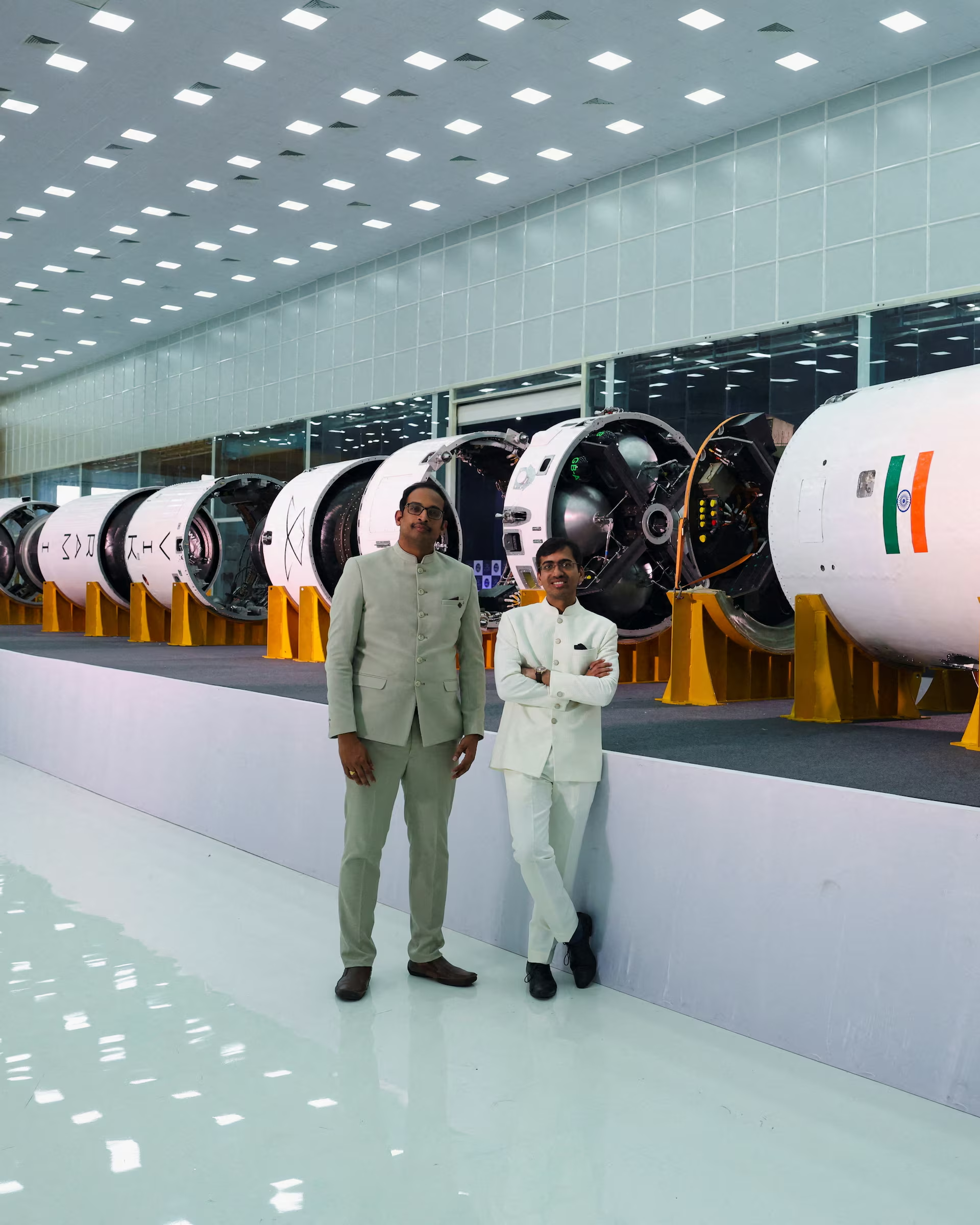
Skyroot has already completed one of the mission’s biggest milestones by stacking all four stages of the sevenstorey Vikram-I rocket into a fully integrated launch vehicle. Engineers are currently conducting detailed system checks, verifying every connection, communication link, and onboard subsystem before receiving final launch clearance.
The company is also testing radar systems, telemetry, launch pad interfaces, and mission control coordination to ensure every element functions seamlessly during launch. Only after these checks, along with weather assessments and range approvals from ISRO, will Vikram-I receive the final goahead.